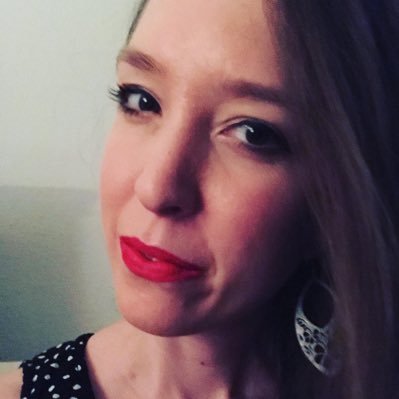
Avid fantasy and spicy romance enthusiast, Jessica Drake-Thomas is a woman of many talents. Her collections, Burials published in 2020 with CLASH Books and Bad Omens published in 2023 with Querencia Press, are full of beautifully crafted poems meant to give voice to the dead, light a fire in your heart, and inspire righteous anger in the shadows of your soul. On March 15, Jessica is releasing Hollow Girls with Cemetery Dance, where children go missing every twelve years when something dark awakens in the woods and hungers for blood.
Sitting down with Jessica was a treat as she opened up about who inspires her as an author and what it means to her to represent the misunderstood and the voiceless through her work.
Q: Who has been your biggest supporter(s) throughout your writing career?
A: My mother has always encouraged me to write. She asked me what I needed to go and become what and who I wanted to be, then gave me the time and space I said I needed to write for a few years. During that time, I wrote all three of my published works: Burials, Bad Omens, and Hollow Girls. Additionally, my boyfriend, my friends, and my sisters have all been a net of support for me and they are always cheering me on. I also feel like my dogs, Poppy and Potato, are support figures. They are always with me when I’m doing the actual writing.
Q: Where do you draw inspiration from in your work?
A: I have always had obsessions with tragedies: ghost stories, the Titanic, the Romanovs, Tudor women who were beheaded, people who go missing without a trace. So far, all of my stories have to do with a kernel of tragic stories that I’ve read obsessively about.
Q: What does it mean to you to be an author?
A: Writing is how I check in with myself. I think other people pray, but I write. Taking that a step further, there’s also a sense of responsibility that comes with being a published writer, to my readers. I know who I am writing for: the younger version of myself. When I was a teenager, I felt like I didn’t have a voice. I certainly didn’t have the language to describe myself; I didn’t know the words “bipolar disorder” or “bisexual.” I had a very conservative, Christian upbringing that was detrimental to my sense of self. I was made to feel like there wasn’t space for me. I am writing stories and poems for the goth kids, the queer kids, the mentally ill kids, even if we’re all grown up now. If my work makes one person feel less alone, then I did what I set out to do.

Q: What is your writing process like? Do you listen to certain music, snack, make loads of phone notes when inspiration randomly strikes, etc.?
A: I write the first and last chapters, and then I do a chapter-by-chapter outline before going in and writing the rest. I make myself Spotify playlists that are based on the mood of the book I’m writing, and I drink cups and cups of lavender and chamomile tea. My Labrador, Poppy, likes to lay with her head on my feet while I write. Tato, my Dalmatian, likes to watch out the window to make sure that we aren’t under attack. I feel very safe while working. Not every hero wears a cape, you know – some wear spots.
Q: Is there a genre or subgenre that you want to explore that you haven’ yet? Conversely, are there any that you’ll never write?
A: I would love to try romantic fantasy or a cozy murder mystery, just because they’re tangential to what I’ve done, but also so very different. I think it would be a lot of fun to attempt. I will never write a literary novel as I have no interest in the genre.
Q: What has been the hardest part of your career as an author so far?
A: I have horrible social anxiety, and it causes me some really big panic moments when the book is first released. I don’t think anyone really talks about how nerve-wracking it is to put a book out there for people to read. It’s horrifying, though I do have to say that everyone has been immensely kind to me.
Q: What do you consider to be your greatest strength and weakness as an author?
A: My strength is that as a writer of horror, I’m pretty good at coming up with the worst thing that could happen. I think a lot about my scenes like, “things are bad, but this is how it could be worse.” My weakness is that I’m really hard on myself. I have a draconian editing practice where I go over the text over and over, word by word, until it’s perfect. It’s exhausting.

Q: At some point in our lives, we’ve all heard the negative comments: “You’re not good enough.” “You’ll never make it.” “This is the worst thing I’ve ever seen.” “You don’t belong.” How do you move forward when faced with negativity?
A: I practice witchcraft.
Q: What advice would you give to women who are wanting to write, especially if it’s something other might perceive as “outside of the norm”?
A: Historically speaking, the literary elite has always talked down upon the writing that women do or love. However, women writers and readers have continued to write and read successfully for hundreds of years. Mary Shelley wrote Frankenstein at eighteen years old. The book is now widely considered a classic, while at the time of publication it was considered pulp. When I was getting my BA and MFA, I was steered away from writing horror. I was told to focus more on literary writing. That was highly detrimental to my journey as a writer. The moment that I fell back in love with Gothic and horror, I found my voice. So, I write for my own pleasure, and I think that’s something all women writers should do, first and foremost.

Discover more from Alpha's Court
Subscribe to get the latest posts sent to your email.


 Alpha's Court
Leave a comment